I spent hours playing with this planet simulator when I first discovered it. Check it out.
Here's a fun challenge: make your own moon!
You'll need to put a planet (Size L) in orbit around the star... make sure you select circle. Then, take a small object (Size S) and fire it just so to get it going around the planet (think of it as a captured satellite). It takes some experimenting, but with a little practice I was able to get two or three going around the planet at the same time. It's tough to keep the orbits stable, though. After a while you're bound to have at least one of them ejected. Extra points if you can eliminate the eccentricity.
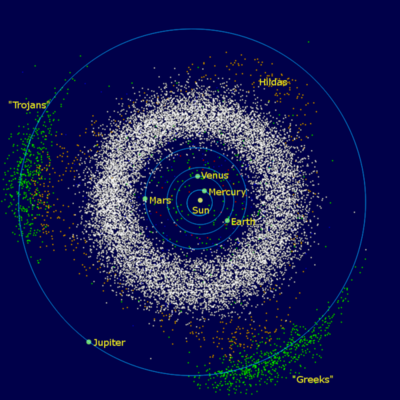
You can also try to replicate the inner solar system (from Mercury to Jupiter). The only problem is, even when you zoom out there isn't adequate space to give the planets an appropriately wide berth for their gravity wells. But it's close enough... just make sure you use small objects for all the terrestrials. Otherwise they'll pull on each other too much.
Don't forget the asteroid belt! And if you add some small objects around Jupiter's orbit, you might get to see some Trojans coalesce at the Lagrangian Points.
If you drop in a few large objects, and clutter it with lots of small objects (which can serve as analogy to the protoplanetary disk), you'll see that most of the small bodies are ejected, or drawn into the sun or planets. It's a marvelous illustration of the simplicity of physics and its capacity to leave us with the graceful solar system we see today.

